
Languages:


Car Rental at 'Trogir - Downtown'
'Trogir - Downtown': Hiring Vehicle
Finding desired car in Trogir
The search options in the above form include pick-up/return date and time, and location criteria. You can play with the options to find the vehicle best suited for your demands.
The address of the preset rental office 'Trogir - Downtown': Obala Bana Berislavica , Trogir, 21220, Kroatia.
To change to another rental area in Trogir, simply use one of the following:
-change the preset location in the 'Pick-up' field in the above form;
-click on one of the links below;
-use the map of Trogir on this page.
Renting a car in Trogir
Best rates. OrangeSmile.com provides cars for hire at the rental point 'Trogir - Downtown' at the lowest guaranteed prices. Our direct car suppliers often provide high discounts on the available models. For your specific dates at 'Trogir - Downtown', we will find for you the best online car hire offers.
The rental process consists of 3 simple steps: (1) search available cars for your dates at 'Trogir - Downtown'; (2) select the car type you wish to rent; and (3) complete the reservation form. Once your reservation at 'Trogir - Downtown' is processed, we will send the confirmation voucher to your email address.
A valid credit card is required to confirm a reservation at 'Trogir - Downtown'. Please check your rental conditions, prior making the reservation.
At the point 'Trogir - Downtown', you will be asked for your confirmation voucher, driving license and a valid credit card. A credit card is required for a safety deposit. The deposit amount at 'Trogir - Downtown' depends on the driver's age and the rented vehicle type.
The definitive payment is usually performed at the pick-up point. Our car suppliers at the point 'Trogir - Downtown' accept VISA, Master Card and other card types - please check your rental conditions.
OrangeSmile.com wishes you safe roads in Kroatia and a pleasant trip to Trogir!
Frequently asked questions on the rental process
The rental process consists of 3 simple steps: (1) search available cars for your dates at 'Trogir - Downtown'; (2) select the car type you wish to rent; and (3) complete the reservation form. Once your reservation at 'Trogir - Downtown' is processed, we will send the confirmation voucher to your email address.
A valid credit card is required to confirm a reservation at 'Trogir - Downtown'. Please check your rental conditions, prior making the reservation.
At the point 'Trogir - Downtown', you will be asked for your confirmation voucher, driving license and a valid credit card. A credit card is required for a safety deposit. The deposit amount at 'Trogir - Downtown' depends on the driver's age and the rented vehicle type.
The definitive payment is usually performed at the pick-up point. Our car suppliers at the point 'Trogir - Downtown' accept VISA, Master Card and other card types - please check your rental conditions.
OrangeSmile.com wishes you safe roads in Kroatia and a pleasant trip to Trogir!
Frequently asked questions on the rental process
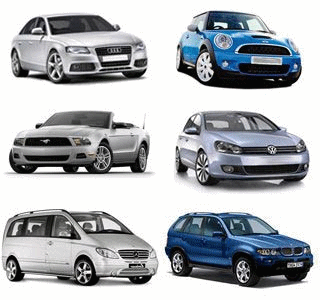
Typical models of OrangeSmile.com vehicles in Trogir
 Mini & economy hatchback:
Toyota Aygo, Hyundai Atos and Ford Fiesta
Mini & economy hatchback:
Toyota Aygo, Hyundai Atos and Ford Fiesta
 Compact & intermediate sedan:
VW Golf, Toyota Auris and Citroen C3
Compact & intermediate sedan:
VW Golf, Toyota Auris and Citroen C3
 Full-size saloon & station wagon:
Audi A4, Renault Scenic and Peugeot 508
Full-size saloon & station wagon:
Audi A4, Renault Scenic and Peugeot 508
 Premium & luxury limousine:
Mercedes C Class, Lexus ES and BMW X3
Premium & luxury limousine:
Mercedes C Class, Lexus ES and BMW X3
 Minivan & minibus, 7-15 pax:
Toyota Previa, Ford Galaxy 7 seater and Peugeot 807 7 seater
Minivan & minibus, 7-15 pax:
Toyota Previa, Ford Galaxy 7 seater and Peugeot 807 7 seater
 SUV, crossover & off-road vehicle:
Toyota Rav4, Kia Sportage and Suzuki Jimny
SUV, crossover & off-road vehicle:
Toyota Rav4, Kia Sportage and Suzuki Jimny
 Cabriolet, roadster & convertible:
Peugeot 206 Cabriolet, Audi A3 Convertible and Mini Classic
Cabriolet, roadster & convertible:
Peugeot 206 Cabriolet, Audi A3 Convertible and Mini Classic
Rental locations near Trogir
Over the sights of Ciovo Island by car
You can see the exposition of the museum of religious art. There are paintings by prominent Serbian artists here, and the objects for liturgy and worship, and even a 14th-century crucifix, which once crowned the triumphal arch on one of the island’s chapels. For those who like art and history, the Dominican monastery of the Holy Cross will also be fascinating. It is located 5 kilometers from Trogir and was built in the 15th century. The Church and Monastery of the Blessed Virgin Mary in Prizidnice, the southern part of Ciovo, is also interesting. The latter, by the way, is also an object of the religious pilgrimage. The remains of the early medieval Church of Saint Fumia can only be reached by boat, as the ruins are located on a small island north-west of Ciovo. This place is also worth visiting.
Read further...
Common questions
Rental conditions
Payment
Changing your booking
Cancelling your booking
Confirmation voucher
Crossing borders
Fuel conditions
Age restrictions
Extra services
Insurance types
Driving license
What does the price include
Payment
Changing your booking
Cancelling your booking
Confirmation voucher
Crossing borders
Fuel conditions
Age restrictions
Extra services
Insurance types
Driving license
What does the price include

HELPDESK
+31 4040 15044
support@orangesmile.com
YOUR BENEFITS
BEST PRICE GUARANTEE
WIDE CHOICE: 25000 HIRE POINTS
BOOKING IN 3 SIMPLE STEPS
INSTANT CONFIRMATION
ONLINE SUPPORT
500.000+ SATISFIED CLIENTS


Popular destination hotels

Alanya
69 hotels
69 hotels

Birmingham
79 hotels
79 hotels

Chester
44 hotels
44 hotels

Gdansk
95 hotels
95 hotels

Jakarta
93 hotels
93 hotels

Lubeck
45 hotels
45 hotels

Mykonos City
60 hotels
60 hotels

Pisa
58 hotels
58 hotels

San Francisco
186 hotels
186 hotels

Thassos
44 hotels
44 hotels