

Pula Hotels
Search hotels
near your address
on Pula map
near your address
on Pula map
The presented room availability, rates and discounts are actual and final for all our 368 hotels in Pula.
BEST PRICE GUARANTEE
500.000+ SATISFIED CLIENTS
CHOICE OF 300.000 HOTELS
BOOKING IN 3 SIMPLE STEPS
INSTANT CONFIRMATION
Best hotels in Pula, Croatia

Address: Verudella 11, Pula
Hotel rating from 833 guests: 8.6
8.6
Hotel rating from 833 guests:
 8.6
8.6
Featuring restaurants serving local specialties and air-conditioned accommodations with balconies and free… Prices, discounts & booking

rates from
EUR 180
Address: Glavica 7, Banjole, Pula
5.6 km from Pula center (hotel on the map)
Hotel rating from 387 guests: 7.7
5.6 km from Pula center (hotel on the map)
Hotel rating from 387 guests:
7.7
Linen is changed weekly, while towels are changed every 4 days. The final cleaning is included in the rate. … Prices, discounts & booking

rates from
EUR 81
Address: Kandlerova 32, Pula
0.3 km from Pula center
Hotel rating from 26 guests: 8.1
0.3 km from Pula center
Hotel rating from 26 guests:
8.1
Free public parking is possible at a distance of 300 metres. … Prices, discounts & booking

rates from
EUR 300
Address: Banovčeva 7, Pula
1.5 km from Pula center
Hotel rating from 6 guests: 7.4
1.5 km from Pula center
Hotel rating from 6 guests:
7.4
Valsaline Beach and the Lungomare promenade are about 500 metres from the Veruda Apartments, while the city centre is 2 km away. … Prices, discounts & booking

Address: Indije 61, Pula
5.3 km from Pula center (hotel on the map)
Hotel rating from 111 guests: 8.7
5.3 km from Pula center (hotel on the map)
Hotel rating from 111 guests:
8.7
Enjoy the beautiful beach and take advantage of the sporting facilities on offer, including a state-of-the-art fitness room. … Prices, discounts & booking

rates from
EUR 111
Address: Pjescana uvala ogranak VI/6, Pula
3.3 km from Pula center (hotel on the map)
Hotel rating from 88 guests: 8.9
3.3 km from Pula center (hotel on the map)
Hotel rating from 88 guests:
8.9
Each apartment at the Villa Canaria includes a well equipped kitchen, a dining area and a living room with a satellite TV. … Prices, discounts & booking

Address: Verudela 11, Pula
Hotel rating from 164 guests: 7.6
Hotel rating from 164 guests:
7.6
With independent villas and residential units, this modern tourist complex is surrounded by abundant vegetation and is close to the seaside. … Prices, discounts & booking

rates from
EUR 50
Address: Epulonova 3, Pula
0.7 km from Pula center
Hotel rating from 124 guests: 7.4
0.7 km from Pula center
Hotel rating from 124 guests:
7.4
The restaurant specializes in Istrian and sea food dishes, as well as pizzas made in the wood oven. … Prices, discounts & booking

rates from
EUR 85.8
Address: Verudela 5, Pula
3.2 km from Pula center
Hotel rating from 54 guests: 8.5
3.2 km from Pula center
Hotel rating from 54 guests:
8.5
Verudela Sport Centre offers tennis courts, scooter rental, diving and paragliding equipment and can be found 400 metres away. … Prices, discounts & booking

rates from
EUR 81
Address: Kandlerova 32, Pula
0.3 km from Pula center
Hotel rating from 7 guests: 6.5
0.3 km from Pula center
Hotel rating from 7 guests:
6.5
A café and restaurant are available next door to the apartments, while a grocery shop can be reached in 10 metres. … Prices, discounts & booking
Hotels in cities & airports nearby Pula
CITIES
Stinjan hotels - 3.9 km
Banjole hotels - 5 km
Fazana hotels - 7.5 km
Medulin hotels - 8.5 km
Premantura hotels - 8.9 km
Krnica hotels - 17.7 km
Bale hotels - 19.8 km
Stinjan hotels - 3.9 km
Banjole hotels - 5 km
Fazana hotels - 7.5 km
Medulin hotels - 8.5 km
Premantura hotels - 8.9 km
Krnica hotels - 17.7 km
Bale hotels - 19.8 km
AIRPORTS
Pula Airport PUY - 6.4 km
Losinj Airport LSZ - 54.6 km
Rijeka Airport RJK - 68.7 km
Portoroz Airport POW - 69.8 km
Pula Airport PUY - 6.4 km
Losinj Airport LSZ - 54.6 km
Rijeka Airport RJK - 68.7 km
Portoroz Airport POW - 69.8 km
Travel guide to Pula, Croatia

Pula topics
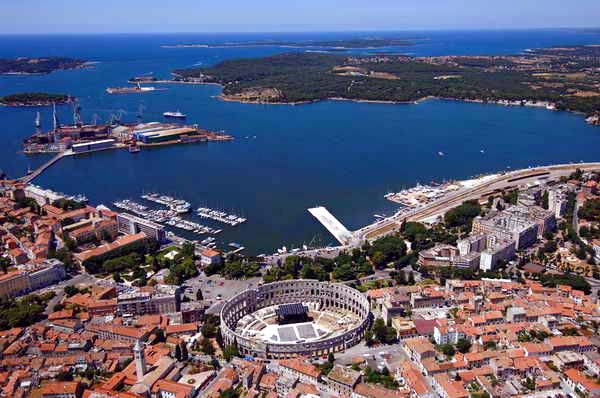
This rich history couldn’t have failed to be reflected in the beautiful historical monuments. The main sight of Pula is the amphitheater called Arena. Its building took place in the 1st century. Today its walls hold theater and opera performances, and film festivals. There are also several monuments of the prehistoric times – the statue of Apollo stands here from the ancient Greeks, while the Romans gave the city a beautiful Temple of Augustus and Sergius Triumphal Arch.
Continue reading
This article about Pula is written by the orangesmile.com editorial team and is protected by the copyright law. The article can only be re-used with a direct link to www.orangesmile.com
Our recent articles related to Pula hotels
 Park Plaza Will Open a Hotel in Croatia
... hotel market of Croatia. Park Plaza Verudela Pula and Park Plaza Histria Pula will undergo a large renovation prior to opening. Both hotels are located on Istrian peninsula, so these will be resorts targeted mostly at leisure travellers. In order to bring the hotels in accordance ... Read complete news
Alila Will Open 2 Hotels in Indonesia
... just 45 minutes away by ferry from Singapore. The hillside location on Pulau Bintan in the amazingly beautiful Lagoi bay will definitely attract the fans of secluded rest, and design made in best traditions of the award-winning Alila Villas Uluwatu and Alila Villas Soori in Bali ... Read complete news
Common Questions
Data securityBooking steps
Credit cards
Money blocking
Booking confirmation
Booking cancellation
Room prices
Hotel options

customer care
+31 4040 15044
support@orangesmile.com
We Accept


Top destinations

Bali
558 hotels
558 hotels

Brugge
143 hotels
143 hotels

Dubrovnik
85 hotels
85 hotels

Heidelberg
65 hotels
65 hotels

Lagos
57 hotels
57 hotels

Marrakech
287 hotels
287 hotels

Oslo
71 hotels
71 hotels

Rethymno
63 hotels
63 hotels

Side
43 hotels
43 hotels

Venice
338 hotels
338 hotels
Our Hotel News
Hilton builds third luxury hotel in Kyoto
Hilton has announced that it will soon begin a project to build a new hotel in Kyoto. It will be located in the heart of the city, in the prestigious...
Read further
2022-04-22
The Kingdom of Saudi Arabia has ambitious plans regarding the historic city of Diriyah that is located only 15 minutes from the central part of Riyadh....
Read further
2021-12-26