You are here:
Car rental »
Malta »
Rules and Traffic Regulations
Language:


Road Rules and Traffic Regulations in Malta - Driving Nuances
1. Tourists, who plan to travel to Malta on a personal car, should not forget that left driving is a standard on the island. Drivers, who are accustomed to right driving, will definitely need some time (approximately one week) to adapt to peculiarities of local roads.
2. Drivers are required to follow basic traffic rules, such as to fasten seat belts and not to use the cell phone while driving. Not only the driver, but also all the passengers in the vehicle must fasten seat belts.
3. In residential areas it is prohibited to move at a speed of higher than 50 km/h, and on some city roads the speed limit is 35 km/h. On country roads, cars are allowed to move at a speed of 80 km/h.
Nuances of Car Rental in Malta
 To save on your rental, we advise to book your car in advance. You will save the most if you do this several weeks or even several months prior to your trip. Rental offices in Malta usually raise rental prices over time, based on the number of cars left available for the accounting period.
When looking for an exotic car (cabriolet, minivan or limousine), we advise to check in the rental offices located at airports, as they usually provide much wider choice comparing to offices in urban areas.
Upon receipt of invoices, bills and documents for your car at the rental location, please compare the obtained data with your voucher. Quite often, employees of rental offices in Malta try to add optional charges or services without informing customers.
It is very important to pick up your car at the rental office in Malta in a correct way. Prior to leaving the office, carefully inspect the car for various defects, and ensure that all the discovered defects are mentioned in your rental documents. In case of a non-compliance found, place a demand for correction to the rental officer.
You can always check our car actual rental offers in Malta. Simply use the search form at the top of the page. We guarantee that you will not find better prices anywhere else!
To save on your rental, we advise to book your car in advance. You will save the most if you do this several weeks or even several months prior to your trip. Rental offices in Malta usually raise rental prices over time, based on the number of cars left available for the accounting period.
When looking for an exotic car (cabriolet, minivan or limousine), we advise to check in the rental offices located at airports, as they usually provide much wider choice comparing to offices in urban areas.
Upon receipt of invoices, bills and documents for your car at the rental location, please compare the obtained data with your voucher. Quite often, employees of rental offices in Malta try to add optional charges or services without informing customers.
It is very important to pick up your car at the rental office in Malta in a correct way. Prior to leaving the office, carefully inspect the car for various defects, and ensure that all the discovered defects are mentioned in your rental documents. In case of a non-compliance found, place a demand for correction to the rental officer.
You can always check our car actual rental offers in Malta. Simply use the search form at the top of the page. We guarantee that you will not find better prices anywhere else!
5. If the car park has yellow road markings, then it is prohibited to park a car on this stretch of a road. It is also forbidden to park a car closer than 12 meters to a public transport stop and closer than 5 meters to crossroads. Of course, you cannot leave your car on sidewalks and crosswalks. If your car is not parked properly, in most optimistic situation you will get a fine, and in case of a pessimistic outcome you will have to pay a fine and your car will be brought to a penalty parking by a tow truck.
6. The condition of main roads in Malta is quite satisfactory, while secondary roads are often not even paved. Drivers, who are used to travelling on large and spacious roads, may become a little confused when they see the width of local roads. Quite often, there is enough space for only one car in each direction.
7. Savvy travelers will definitely appreciate the fact that all roads in Malta are free. When driving on roads of Malta, foreign visitors are recommended not to trust all road signs – quite often road signs display information that is wrong or already not valid. In the countryside, road signs are quite rare.
8. The total length of roads in Malta is a bit more than 3,000 km, 2,700 km of the roads are paved. In large cities, the quality of roads deserves the highest praise, so it is very comfortable to drive on them.
10. In Valletta, there is a definite shortage of free parking spaces. Inexperienced drivers will find it very hard to find a free parking space in downtown areas. There are so called half-way parking lots in Valletta suburbs, where you can leave your car and then reach the downtown by special buses.
11. Driving while intoxicated is considered a very serious traffic violation. The permitted blood alcohol content for drivers is 0.8‰. If the blood alcohol level is between 0.8 and 1.0‰, the violator will get fined 1,200 euro. In this case, the imprisonment of up to three months can be provided as an additional punishment for the violation.
12. If the blood alcohol content is more than 1.0‰, then the violator’s driving license is likely to be cancelled. A prison sentence for six months is an additional punishment for this traffic violation. Do not refuse to pass the breath test, because your refusal would be inevitably followed by the most severe punishment for this type of violation.

Popular cities in Malta with OrangeSmile.com rental points

AVIS

ALAMO

BUDGET

DOLLAR

RENT-A-CAR

EUROPCAR

NATIONAL

PAYLESS

SIXT

THRIFTY
OrangeSmile.com travel services
 BEST PRICE GUARANTEE
100.000+ SATISFIED CLIENTS
WIDE CHOICE: 25.000 HIRE POINTS
BOOKING IN 3 SIMPLE STEPS
INSTANT CONFIRMATION
BEST PRICE GUARANTEE
100.000+ SATISFIED CLIENTS
WIDE CHOICE: 25.000 HIRE POINTS
BOOKING IN 3 SIMPLE STEPS
INSTANT CONFIRMATION
FAQ: Common questions
Rental conditionsPayment
Changing your booking
Cancelling your booking
Confirmation voucher
Crossing borders
Fuel conditions
Age restrictions
Extra services
Insurance types
Driving license
What does the price include

HELPDESK
+31 4040 15044
support@orangesmile.com
We accept


Top destinations

Barcelona
17 rental points
17 rental points

Cancun
16 rental points
16 rental points

Chersonissos
8 rental points
8 rental points

Frankfurt
20 rental points
20 rental points

Indianapolis
6 rental points
6 rental points

Lyon
8 rental points
8 rental points

Milan
24 rental points
24 rental points

Playa del Carmen
8 rental points
8 rental points

Tenerife
8 rental points
8 rental points

Toronto
24 rental points
24 rental points
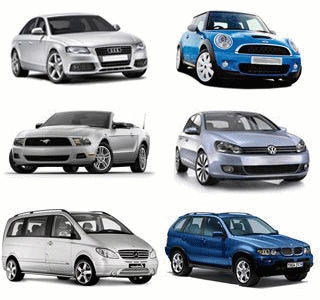
Cars to rent in Malta